
Rotator Cuff Tear Treatment in Modesto, CA
The rotator cuff is a group of four muscles and tendons that hold the ball of the shoulder in its socket and help lift and rotate the arm. A tear can happen suddenly, from a fall or lifting something heavy, or develop slowly from wear over time.
What Is a Rotator Cuff Tear?
The rotator cuff is a group of four muscles (the subscapularis, supraspinatus, infraspinatus, and teres minor) and their tendons. They surround the shoulder joint, hold the ball of the upper arm bone in its shallow socket, and help you lift and rotate your arm.
A rotator cuff tear is a tear in one or more of these tendons. In a partial tear the tendon is damaged but not fully severed. In a full-thickness tear the tendon has detached completely from the bone. The supraspinatus tendon is the one most often torn.
Causes
- Overuse: common in athletes and in people whose work involves repeatedly raising the arms overhead.
- Injury: some tears happen suddenly, such as in a fall onto an outstretched arm.
- Age-related wear: the muscles and tendons weaken over time, which makes tears more likely.
Symptoms of a Rotator Cuff Tear
- Pain when lifting the arm overhead
- Pain at night, particularly when lying on the affected side
- A dull ache in the shoulder that disrupts sleep
- Weakness in the arm
- Trouble with daily tasks such as combing your hair or reaching behind your back
Read more in Dr. Giang’s article on how to tell if you have a rotator cuff tear.
How a Rotator Cuff Tear Is Diagnosed
Dr. Giang discusses your symptoms and examines the shoulder. An X-ray or MRI is typically ordered to check for damage and to show whether the tear is partial or full-thickness.
Can a Rotator Cuff Tear Heal on Its Own?
It depends on the size of the tear, how well the shoulder is functioning, your overall health, and your age. Larger tears are harder to heal and often need surgery. An untreated tear can lead to lasting weakness or loss of motion, and a torn tendon may retract, which makes treatment more complicated.
Dr. Giang covers this question in more detail in Can a Torn Rotator Cuff Heal on Its Own?
Nonsurgical Treatment
For small tears, treatment usually starts with rest, ice, anti-inflammatory medication, and physical therapy to strengthen the muscles. A steroid injection can provide temporary pain relief, but it is not a long-term solution because repeated injections can weaken the tendon.
Arthroscopic Rotator Cuff Repair
When surgery is needed, the usual approach is arthroscopic repair, performed through small incisions using a camera called an arthroscope.
- Full-thickness tear: the tendon is reattached to the bone using anchors and sutures.
- Partial tear: the damaged tissue may only need to be trimmed or smoothed.
The procedure takes about an hour and can usually be done as outpatient surgery. Open repair through a larger incision is less common and is used in some situations. When a tear cannot be repaired and arthritis has developed, reverse shoulder replacement may be an option.
Recovery After Rotator Cuff Repair
The arm is kept in a sling for about four to six weeks, and physical therapy starts soon after surgery to restore range of motion and prevent stiffness. Most people regain full range of motion and strength within four to six months.
Larger tears, the quality of the tendon tissue, older age, and not following the rehabilitation plan can lengthen recovery.
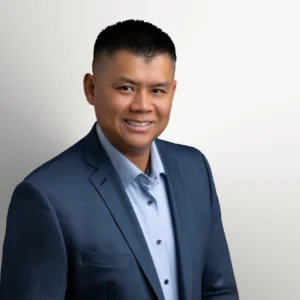
Fellowship-trained. Board certified. Here in Modesto.
Dr. Giang is a board-certified orthopedic surgeon who completed a fellowship in shoulder and elbow surgery at the Carrell Clinic in Dallas. He sees patients at his office on Coffee Road, where same-day appointments may be available, and the office speaks English and Spanish.
Ready to talk about your shoulder pain?
Call (209) 577-1411 or request an appointment online. Same-day appointments may be available at our Modesto office on Coffee Road.