Medically reviewed by Eric L. Giang, DO | Reviewed June 2026
When patients come to see me about knee replacement surgery in Modesto, many of their questions focus on recovery time, pain management, and when they can get back to doing the things they love. What they do not always think to ask, but what I consider one of the most important decisions in the procedure, is how I will actually access the knee. Two of the approaches I use regularly are the medial parapatellar approach and the subvastus approach. I choose between them based on the patient, the anatomy, and the specifics of the surgery itself.
Key Takeaways
- The surgical approach to knee replacement determines how the surgeon accesses the joint and can influence early recovery and function.
- The medial parapatellar approach is the most widely used technique and offers excellent exposure, making it well-suited for complex cases.
- The subvastus approach avoids cutting through the quadriceps tendon, which may support faster early quad activation and reduced blood loss in appropriate candidates.
- Not every patient is a candidate for every approach. Anatomy, body type, and the complexity of the surgery all factor into the decision.
Understanding the Anatomy First
To understand why the surgical approach matters, it helps to understand a little bit about what surrounds the knee. The quadriceps muscle group runs down the front of your thigh and connects to the kneecap (patella) through the quadriceps tendon. The patella itself connects to the tibia via the patellar tendon. This entire complex is what allows you to straighten your leg, and it sits directly in the path of the incision for almost every knee replacement.
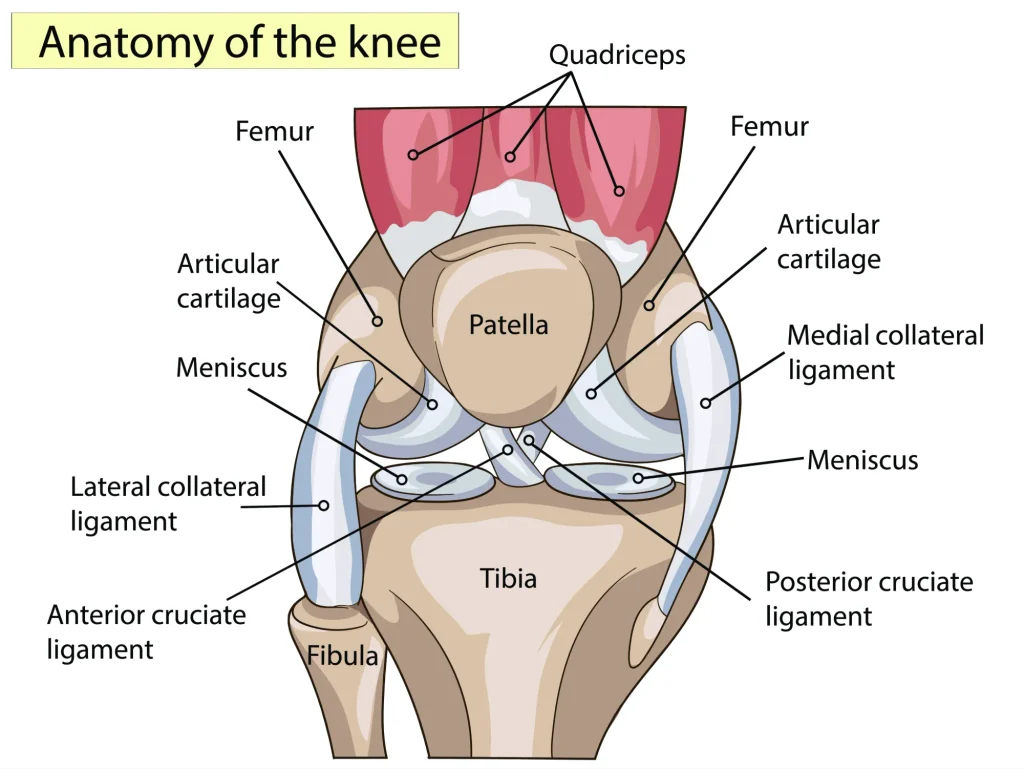
Different approaches navigate this anatomy in different ways, and those differences can influence how quickly the muscle recovers function after surgery. This is the core reason why surgical approach matters beyond the technical exposure it provides.
The Medial Parapatellar Approach
The medial parapatellar approach is a commonly used technique in knee replacement surgery. The incision runs along the inner (medial) border of the quadriceps tendon and the patella. To gain access to the joint, I make a cut through the quadriceps tendon itself and reflect the kneecap (patella) to the outside of the knee.
This gives me excellent visualization of the entire joint. I can see the medial compartment, the lateral compartment, and the area behind the patella clearly. When I am dealing with a complex anatomy, a patient with significant deformity, a larger body habitus, or a revision situation, that exposure is valuable. I do not want to be working through a limited view when precision is everything.
The trade-off is that because I cut through a portion of the quadriceps tendon, the quad has to heal in addition to everything else your body is managing post-operatively. That does not typically prevent a good outcome, as most patients recover quad function well with physical therapy, but it is a consideration.
The Subvastus Approach
The subvastus approach takes a different path to the joint. Rather than going through the quadriceps tendon, I route around it, passing underneath the vastus medialis muscle (the teardrop-shaped muscle on the inner part of the quad) and entering the joint without cutting the tendon itself.
The potential advantages of this approach are meaningful. Because I avoid a direct cut through the quad mechanism, some patients experience faster quadriceps activation in the early post-operative period. There is also evidence suggesting the subvastus approach may be associated with less blood loss, less early pain, and potentially shorter hospital stays in the right candidates.
The limitation is exposure. The subvastus approach is technically more demanding, and in patients with tight anatomies (those who are heavier, more muscular, or have limited pre-operative knee motion) the exposure can be restricted. The accuracy of component alignment and joint balancing is paramount to long-term outcomes, so I will always choose the approach that gives me what I need surgically.
I use the subvastus approach selectively. When I have a patient with a reasonable body habitus, good pre-operative range of motion, and a straightforward anatomy, it is a strong option.
What I See in My Patients
Over the years treating knee patients across the Central Valley, I have come to appreciate that patients care deeply about getting back on their feet quickly. Most of my patients are working adults, retirees who want to stay active, or people who have been dealing with pain long enough that they want their lives back as soon as possible.
When a patient is a strong candidate for the subvastus approach, I tend to see them making meaningful early strides in physical therapy. The quad fires earlier, the swelling may be slightly less pronounced, and they often feel more confident moving the knee in those first couple of weeks. That early progress can set a positive tone for the entire recovery.
That said, I have also seen patients do exceptionally well after medial parapatellar approaches, including complex cases where the subvastus simply was not feasible. What matters most is precise implant placement and a well-balanced joint. No early recovery advantage from an approach offsets a sub-optimally placed implant over the long haul.
My Approach to Choosing Between Them
My decision is driven by the patient in front of me, not by a default preference. I consider several factors:
- Body habitus and build. Patients with larger thighs or heavier builds tend to require the broader exposure the medial parapatellar approach provides.
- Pre-operative range of motion. A knee that is already quite stiff can make the subvastus approach technically difficult.
- Degree of deformity. Significant varus or valgus deformity often requires more extensive exposure.
- Revision or primary procedure. Revision cases usually require the medial parapatellar approach due to the increased complexity.
I am also a believer in using robotic assistance to maximize the precision of my implant placement regardless of the approach. The NAVIO robotic system I use allows for real-time intraoperative adjustments, and it pairs with either approach. The combination of thoughtful approach selection and robotic precision is what I offer my patients.
If you are considering knee replacement and curious about what approach I might use in your specific case, that is a great conversation to have at your consultation. I will review your imaging, assess your anatomy, and explain my thinking clearly.
Summary
The surgical approach to total knee replacement is a decision I take seriously for every patient. The medial parapatellar approach offers reliable, broad exposure and is my go-to technique for complex cases, revision surgeries, and patients whose anatomy limits other options. The subvastus approach offers a meaningful alternative for the right candidate. Choosing between them is about what gives you the best possible outcome.
If you are exploring knee replacement options in Modesto and want to understand what approach might be right for you, give my office a call at (209) 577-1411 or request an appointment online.
Frequently Asked Questions
How do I know which approach is right for me?
That is something I determine after reviewing your imaging, assessing your anatomy, and discussing the specifics of your case during a consultation. There is no single answer that applies to every patient. Factors like your body type, the degree of joint damage, and whether this is a primary or revision procedure all influence the decision.
Does the surgical approach affect how long surgery takes?
In experienced hands, the difference in operative time between these approaches is generally minor. The subvastus approach can take slightly longer in difficult cases due to the more limited exposure. For most straightforward primary replacements, operative time is similar between the two techniques.
Will I know ahead of time which approach my surgeon will use?
Yes, I discuss this with patients at the pre-operative visit. That said, I do reserve the right to modify my approach intraoperatively if I encounter anatomy or findings that make a different technique safer or more appropriate. I want to make the best decision in the moment for your outcome.
Can the approach affect how quickly I recover?
The approach may influence early recovery, particularly quad activation in the first few weeks. Some studies suggest the subvastus approach may support faster early quadriceps function in appropriate candidates. That said, the long-term functional outcomes between well-executed approaches are generally comparable. Physical therapy and patient commitment to rehabilitation matter enormously regardless of which approach is used.