
Medically reviewed by Eric L. Giang, DO | Reviewed May 2026
I see a version of this scenario often in my Modesto practice. A patient comes in after weeks, sometimes months, of pushing through knee pain, hoping it would sort itself out. By the time I see them, what might have started as a manageable injury has sometimes become more complicated. If you’re asking whether walking on a torn meniscus can make it worse, the honest answer is yes, it can.
That doesn’t mean every step you take is doing damage. But continuing high-impact or strenuous activity on an undiagnosed tear may slow healing, drive up inflammation, and, depending on the tear type, turn a smaller problem into a much bigger one. Understanding what’s happening inside the joint can change the direction of your recovery.
Key Takeaways
- Walking on a torn meniscus can worsen the tear, increase swelling and pain, and delay recovery, especially with high-impact activity.
- The severity of the injury and the right treatment path depend on the tear type, location, and overall knee health.
- Some minor tears respond well to conservative care; others require surgical intervention to restore function.
What the Meniscus Actually Does
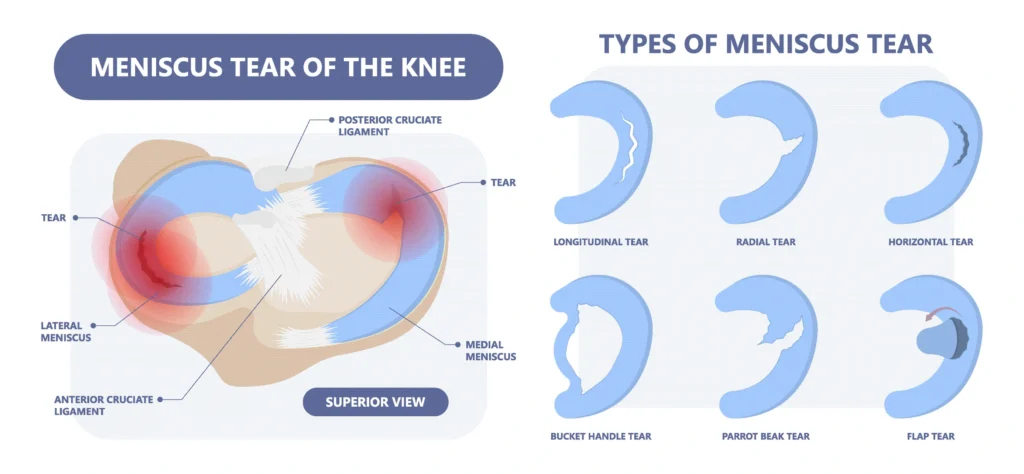
The meniscus is a C-shaped piece of cartilage sitting between the thighbone and the shinbone in the knee. You have two of them: the medial meniscus on the inner side and the lateral meniscus on the outer side. Together, they act as shock absorbers, help distribute load evenly across the joint, and contribute to knee stability during movement.
With each step, the knee bears roughly one-and-a-half times your body weight. Over the course of a day, that adds up to an enormous cumulative load. The meniscus isn’t just padding. It also helps keep joint fluid in the right place and reduces friction as the bones move against each other. When it tears, those protective functions are compromised, and force starts traveling through the joint in ways it wasn’t designed to handle.
How Meniscus Tears Happen
Tears generally fall into two categories. Acute tears result from a sudden forceful movement, such as a twist or rotation of the knee with the foot planted. Athletes who pivot, cut, or change direction quickly face a higher risk.
Degenerative tears are different. They develop gradually as the meniscus tissue weakens with age. For some patients, something as minor as an awkward step or rising from a low chair can trigger a tear. This type tends to show up more in patients over 40. The distinction matters because it shapes what treatment options make the most sense.
What I See in My Patients
Most patients with meniscus tears reach my office after weeks of trying to manage the pain on their own. They describe a dull ache along the knee joint line that sharpens with stairs, squatting, or prolonged walking. Some notice swelling that builds up after activity and fades with rest. Others describe a catching or locking sensation, like something inside the knee is snagging with certain movements.
What gets my attention as a surgeon isn’t always the pain level. It’s the mechanical symptoms. A knee that locks, catches, or gives way unpredictably often suggests a displaced or unstable tear, and those tend to be harder to manage without surgery. The earlier I see someone with those symptoms, the more treatment paths remain open to us.
Here in Modesto and the broader Central Valley, I treat an active population. Young athletes from youth soccer and basketball programs. Adults in their 50s and 60s who hike, golf, or work physical jobs. All of them tend to push through pain longer than they should. I understand the impulse, but with meniscus tears, waiting rarely makes things easier to treat.
Why Walking on It Can Make Things Worse
Not all tears respond the same way to continued loading. A small, stable tear in the outer rim of the meniscus, where blood supply is relatively better, may tolerate some weight-bearing without serious consequences. Larger tears, unstable tears, and tears in the inner portion of the meniscus, where blood supply is limited, are a different story.
Continued loading can cause a tear to extend. Think of a small cut in a piece of fabric. Ongoing tension keeps pulling it apart. Over time, mechanical stress on a torn meniscus may increase joint inflammation, accelerate cartilage wear, and contribute to early-onset arthritis. Swelling that reliably returns after activity is usually a sign the knee is absorbing more than it can handle well.
High-impact exercise, deep squatting, and heavy lifting should generally be avoided until you have a clear diagnosis. Low-load walking may be tolerable for some, but even that depends on the tear.
My Approach to Treatment
When I evaluate a patient for a suspected meniscus tear, I start with a thorough clinical exam. I’m assessing range of motion, joint line tenderness, and any signs of mechanical dysfunction. From there, an MRI typically gives the clearest picture of the tear’s size, location, and pattern, details that drive every treatment decision.
Minor, stable tears in older patients often do well with conservative management. That typically means a structured period of rest, activity modification, and physical therapy to restore strength and stability around the knee. My threshold for recommending surgery early is higher for this group, because many of these patients can do very well without it.
For patients dealing with persistent pain but not ready for surgery, I sometimes discuss PRP therapy as a supportive, non-surgical option. PRP uses concentrated growth factors from the patient’s own blood, injected into the knee, with the goal of supporting the body’s natural repair process.
When conservative treatment isn’t working, or when there’s a mechanical issue like a locked knee, surgery may be recommended. Meniscus surgery is typically done arthroscopically, with two common approaches: repair of the torn tissue, or partial removal of the damaged portion when repair isn’t viable. I lean toward repair whenever it’s anatomically possible, especially in younger patients, because preserving meniscal tissue protects the long-term health of the knee.
For patients who have progressed to significant joint damage over time, robotic knee replacement may ultimately be the right path. In my practice, I use the NAVIO robotic system, which allows for precise, patient-specific planning and implant placement tailored to each individual’s anatomy.
Steps You Can Take Right Now
While you’re waiting to be seen, a few basic measures may help reduce discomfort and prevent the injury from getting worse.
- Rest and protect the knee. Reduce activities that provoke pain. Avoid deep squats, pivoting, or movements that cause the knee to catch or lock.
- Ice. Applying ice for 15–20 minutes at a time, several times a day, may help reduce swelling and discomfort.
- Compression. A compression wrap or sleeve may provide some support and limit swelling during daily activity.
- Elevate when possible. Keeping the leg elevated above heart level can help control swelling, especially in the first few days.
These measures aren’t a treatment plan. They’re ways to manage symptoms while you get a proper evaluation.
Summary
A torn meniscus doesn’t always end in surgery. Many patients recover well with the right conservative approach. But continuing to walk and load an injured knee without knowing what you’re dealing with may turn a treatable problem into a more complex one. The tear pattern, its location, and how the knee responds over time all factor into what treatment makes sense.
If you’ve been dealing with knee pain, swelling, or any catching or locking that doesn’t improve with rest, the next right step is an evaluation. My office in Modesto is here for exactly this — we offer same-day appointments and can help you understand what’s happening and what your options are. Call us at (209) 577-1411 or schedule a visit online to get started.
Frequently Asked Questions
Can I walk on a torn meniscus?
Short walks on flat surfaces may be manageable for some patients, depending on the tear type and severity. That said, continued loading, especially stairs, inclines, or any activity that causes pain, can worsen a tear over time. Getting a diagnosis before continuing normal activity is the safest approach.
How do I know if I have a torn meniscus?
Common signs include pain along the joint line, swelling that develops gradually or after activity, stiffness, and mechanical symptoms like catching, locking, or a knee that feels like it might give way. An MRI is typically needed to confirm the diagnosis and determine the tear’s extent and location.
Does a torn meniscus always require surgery?
No. Many tears, particularly smaller, stable tears in older patients, can be managed without surgery through rest, physical therapy, and activity modification. More complex tears, or those causing mechanical symptoms, are more likely to require a surgical solution. The right answer depends on the individual case.
What happens if a torn meniscus goes untreated?
Over time, an untreated meniscus tear may lead to progressive cartilage wear, increasing pain, and reduced knee function. In some cases, it can accelerate the onset of arthritis in the joint. Early intervention, whether conservative or surgical, generally produces better outcomes than waiting.