Medically reviewed by Eric L. Giang, DO | Reviewed June 2026
Hip labral tears are something I see often in my Modesto practice, and they’re one of those injuries that can be tricky to identify without the right evaluation. Patients come in describing a deep ache around the groin, a catching sensation in the hip, or pain that started after a sports injury and just never fully resolved. If you’ve been dealing with persistent hip pain that doesn’t seem to respond to rest or basic treatment, understanding what a hip labral tear is, and what can actually be done about it, is a good place to start.
Key Takeaways
- The labrum is a ring of cartilage that stabilizes the hip socket, and tears can develop from acute injury, repetitive stress, or structural problems in the joint.
- Common symptoms include groin pain, clicking or catching in the hip, stiffness, and discomfort that worsens with prolonged sitting, walking, or athletic activity.
- Diagnosis typically involves a physical exam, imaging, and sometimes a diagnostic injection to confirm the labrum is the source of pain.
- Treatment ranges from physical therapy and activity modification to minimally invasive hip arthroscopy, depending on the tear’s severity and how well conservative options work.
What Is the Hip Labrum?
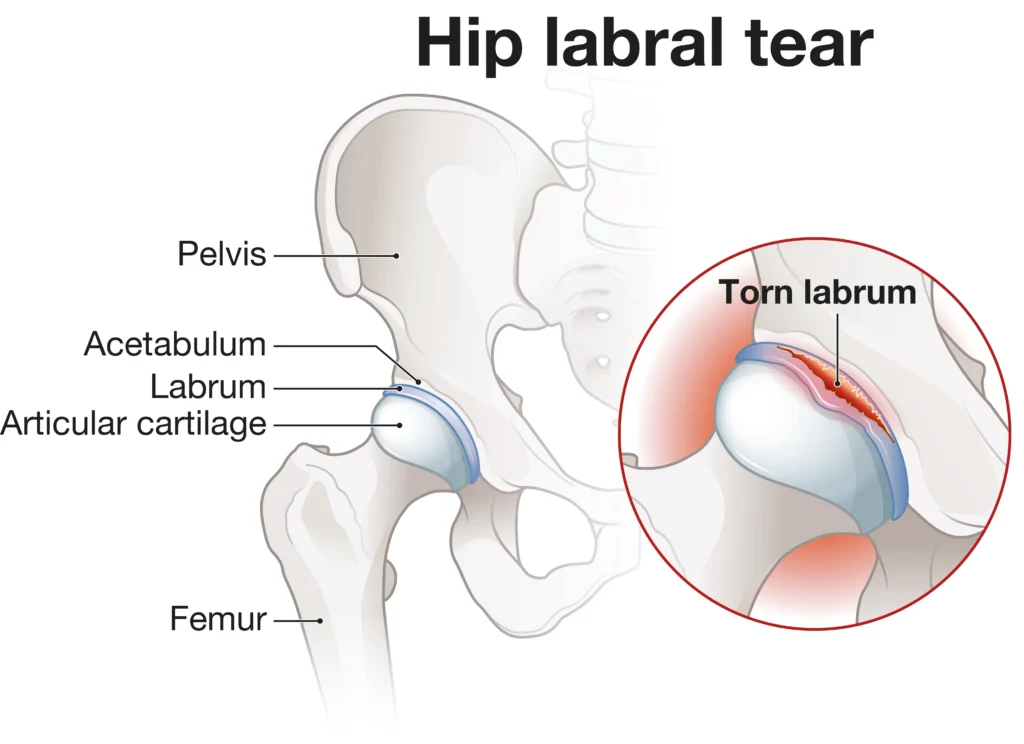
The labrum is a ring of fibrocartilage that lines the rim of the hip socket, or acetabulum. It deepens the socket, which helps keep the ball of the femur securely in place. Without it, the hip joint would have significantly less stability and shock absorption. The labrum also creates a seal that maintains fluid pressure inside the joint, which helps lubricate the cartilage surfaces during movement.
Labral tears can be partial or complete. They tend to occur at the front of the hip, where the joint experiences the most stress during flexion and rotation. Athletes who play sports involving repetitive pivoting (soccer, hockey, basketball, and certain martial arts) are at higher risk, but labral tears also develop in non-athletes, particularly in people with underlying structural issues like hip impingement.
What Causes a Hip Labral Tear?
There are generally three categories that account for most hip labral tears I evaluate:
Structural abnormalities are probably the most common underlying cause I see. Femoroacetabular impingement (FAI) is a condition where the bones of the hip joint don’t fit together quite right. Over time, this abnormal contact damages the labrum. Many patients have had subtle hip anatomy differences their whole lives but only start experiencing symptoms in their 20s, 30s, or 40s when activity levels or years of repetitive stress finally tip the scales.
Acute injury is the second driver. A fall, sudden pivot, or traumatic impact can tear the labrum directly. This sometimes happens during contact sports or even car accidents.
Degenerative changes round out the picture. As hip cartilage breaks down over time, as with osteoarthritis, the labrum can become frayed and weakened. In these cases, the labral tear is often a sign of broader joint health issues rather than an isolated injury.
Recognizing the Symptoms
A symptom I commonly see is pain in the front of the hip, often felt in the groin. Patients sometimes describe it as a dull ache at rest that sharpens with specific movements. Prolonged sitting is a common aggravator, and people who work desk jobs frequently tell me their pain peaks after long stretches in a chair.
Mechanical symptoms are another possible sign. A clicking, locking, or catching sensation in the hip during movement suggests the torn labral tissue may be getting caught in the joint. Not every labral tear produces these sounds, but when they’re present alongside pain, they’re meaningful.
Patients may also notice difficulty rotating the hip, getting in and out of a car, or crossing their legs. Some describe a feeling of instability, like the hip might “give way” during activity. Left untreated, chronic irritation in the joint can accelerate cartilage wear, which is one of the reasons I don’t like taking a wait-and-see approach when a labral tear is suspected.
What I See in My Patients
Here in Modesto and across the Central Valley, I evaluate a wide range of patients with hip pain, from high school athletes and weekend warriors to people in their 50s and 60s who’ve been managing discomfort for years and are finally looking for answers. A few patterns come up repeatedly.
Young athletes, especially those in soccer and basketball, often come in after an injury that never fully healed. They’ve tried rest, maybe some physical therapy, but the groin pain keeps coming back when they try to return to play. That history of a persistent, activity-limiting hip problem in an active younger person is a flag for me.
I also see a fair number of patients who’ve been told their hip pain is a “strain” or “hip flexor tightness” for months or even years before a labral tear is identified. The groin is not an intuitive location for people to associate with the hip, and labral tears don’t show up on standard X-rays. By the time some patients reach me, they’ve had significant delays in getting the right diagnosis. That’s frustrating, because earlier identification generally means more options on the treatment side.
One thing I tell patients: the catching sensation matters. When someone describes a hip that clicks or locks during specific movements, particularly rotation, that symptom warrants a closer look.
How a Hip Labral Tear Is Diagnosed
Diagnosis starts with a thorough history and physical exam. Tenderness with specific positions, a positive impingement sign, and restricted range of motion all help build the clinical picture. Imaging is usually the next step. Plain X-rays can reveal structural issues like FAI or hip dysplasia, but they don’t show soft tissue. MRI, particularly MR arthrography where contrast dye is injected into the joint before the scan, provides much better visualization of the labrum and can identify the location and extent of a tear.
In some cases, a diagnostic injection of local anesthetic into the hip joint can also be useful. If a patient’s pain is significantly reduced following the injection, that strongly suggests the hip joint is the pain generator. It helps rule out pain sources outside the joint, like hip flexor or gluteal pathology, which can sometimes mimic labral tear symptoms.
My Approach to Treatment
When I sit down with a patient who has a confirmed hip labral tear, my first question isn’t “do you need surgery?” It’s “what are your goals, and what have you already tried?” The treatment path depends on the severity of the tear, whether there’s an underlying structural cause, the patient’s activity level, and how much the symptoms are affecting daily life.
For many patients, a structured non-surgical program is a reasonable starting point. Physical therapy focused on hip stabilization, core strengthening, and movement mechanics can reduce stress on the labrum and improve function. Anti-inflammatory medications and activity modification can also help manage symptoms during this period. For patients who are not surgical candidates or who want to explore every conservative option first, platelet-rich plasma (PRP) therapy may be worth discussing.
When conservative treatment doesn’t produce adequate improvement, or when there’s a structural issue that’s continuing to damage the labrum, I discuss the option of hip arthroscopy. This is a minimally invasive procedure performed through small incisions. Using a camera and specialized instruments, I can repair or reconstruct the torn labrum and address any bony impingement that may be contributing to the problem.
I want to be clear: I don’t recommend surgery for every labral tear. The decision is individualized. But when a patient has ongoing symptoms that limit their quality of life, when imaging shows a significant tear, or when there’s an impingement problem that’s going to keep damaging the joint, surgery is often the right conversation to have. The goal is to protect long-term hip health, not just manage short-term pain.
Summary
A hip labral tear can be a surprisingly under-recognized source of chronic hip and groin pain. The combination of aching discomfort, mechanical symptoms like clicking or catching, and reduced range of motion warrants a proper evaluation rather than a wait-and-see approach. The good news is that we have real tools to address this, from targeted physical therapy and PRP to hip arthroscopy when the situation calls for it.
If you’re in the Modesto or Central Valley area and you’ve been dealing with hip pain that doesn’t seem to have a clear explanation, I’d encourage you to come in for an evaluation. The right diagnosis is the foundation of the right treatment plan.
Frequently Asked Questions
Can a hip labral tear heal on its own?
The labrum has limited blood supply, which means it does not heal as reliably as other tissues. Minor irritation may settle with rest and physical therapy, but significant tears are unlikely to fully resolve on their own. Conservative treatment can reduce symptoms and improve function, but it typically does not repair the tear structurally. For patients with ongoing symptoms, a surgical consultation may be considered.
How do I know if my hip pain is coming from the labrum?
Labral tear pain tends to sit in the front of the hip or groin and often worsens with prolonged sitting, pivoting, or end-range hip movements. Clicking, locking, or catching sensations are particularly suggestive. That said, hip pain has many potential causes, and the only reliable way to determine whether the labrum is involved is through a clinical evaluation and appropriate imaging.
Can I still exercise with a hip labral tear?
Many patients can continue some level of activity with a labral tear, though high-impact or rotational movements that reproduce pain should generally be avoided until the situation is properly evaluated. A physical therapist can help modify your routine to reduce stress on the labrum while maintaining fitness. Pushing through significant pain is not advisable, as continued mechanical stress on a torn labrum can worsen the injury and accelerate cartilage damage.