
Medically reviewed by Eric L. Giang, DO | Reviewed August 2026
A patient described it to me recently as feeling like his knee was “one wrong step away from giving out.” That sense of unpredictability, of a joint that might buckle without warning, is something I regularly hear about in my Modesto practice. It shows up in athletes after a twisting injury, in older patients with worn-out cartilage, and even in people who can’t pinpoint when it started. In this post, I want to break down knee instability: causes, treatment, and when surgery helps, because understanding what’s actually happening inside the joint tends to ease a lot of the anxiety that comes with that “giving way” feeling.
Key Takeaways
- Knee instability usually stems from ligament damage (ACL, MCL, PCL, or LCL), meniscus injury, or long-standing arthritis that has worn away the structures that normally keep the joint steady.
- A feeling of the knee “giving way” shouldn’t be ignored, even if it doesn’t happen often, since repeated episodes can cause further damage inside the joint.
- Many cases of knee instability respond well to bracing and targeted physical therapy, though ligament tears and advanced arthritis-related instability sometimes require surgery to restore lasting stability.
What Knee Instability Feels Like
Knee instability describes a knee that doesn’t feel dependable during normal movement. Patients describe it in different ways: a buckling sensation while walking downstairs, a shift or wobble during a pivot, or a general sense that the knee might give out without warning.
It’s different from a patellar dislocation, where the kneecap itself slips out of its groove. Instability more often points to a problem with the ligaments or cartilage that stabilize the deeper structures of the joint.
Instability can be constant or occasional, mild or severe enough to affect basic daily movement. Some patients notice it only during sports or on uneven ground. Others feel it just walking across a parking lot. The common thread is a loss of confidence in the joint, which tends to change how people move even when the knee technically “holds up.”
What Causes Knee Instability
Several different problems can produce that unstable feeling, and they don’t all point toward the same treatment. Ligament injuries are among the most common causes, particularly tears of the anterior cruciate ligament (ACL), which connects the thigh bone to the shin bone and helps control rotational movement. ACL tears often happen during sudden pivots or direction changes in sports like soccer or basketball, and the classic sign is a knee that gives way specifically during those cutting motions.
The medial collateral ligament (MCL), posterior cruciate ligament (PCL), and lateral collateral ligament (LCL) can also tear, usually from a direct blow or an awkward twist, each producing a slightly different pattern of instability. Meniscus tears, damage to the cartilage cushions between the femur and tibia, can contribute to a sense of catching or instability as well, especially when a torn fragment shifts within the joint.
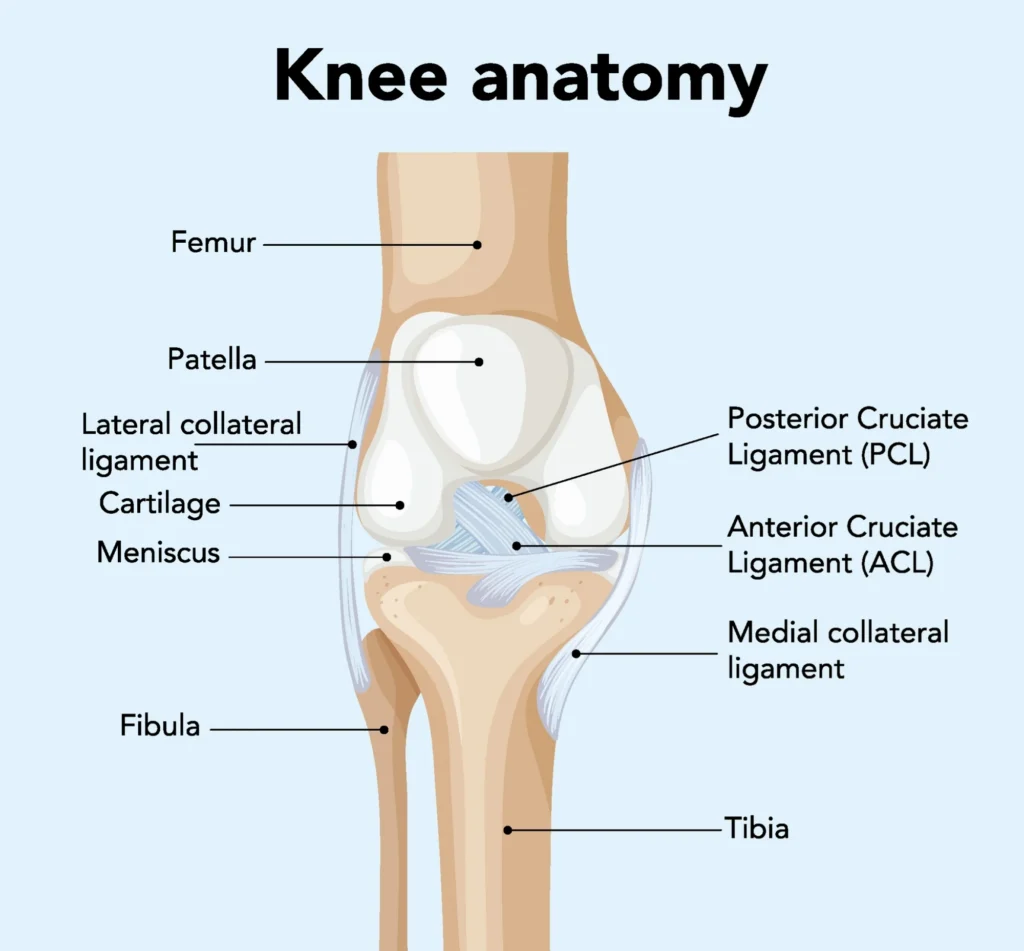
In older patients, longstanding knee osteoarthritis can gradually wear down cartilage and loosen the soft tissue support around the joint, producing instability that develops slowly rather than from a single injury. Muscle weakness, particularly in the quadriceps and hip stabilizers, can compound any of these underlying issues, since strong muscles help compensate for looser ligaments.
Symptoms and How It’s Diagnosed
The two details I ask about most directly are frequency and triggers. How often does the knee feel unstable, and what specifically seems to bring it on? A knee that gives way during pivoting or cutting points toward ligament involvement, while instability that’s worse going down stairs or after prolonged walking may suggest arthritis-related changes.
Swelling that shows up soon after an instability episode is another detail worth mentioning at your appointment, since it can indicate active inflammation or a new injury layered on top of an older one. Diagnosis typically starts with a physical exam that tests the specific ligaments for laxity, followed by imaging. X-rays help evaluate joint space and arthritis, while an MRI gives a clearer picture of ligament and meniscus damage that X-rays can’t show on their own.
What I See in My Patients
In my Modesto practice, I see two very different populations dealing with knee instability. There’s the younger, athletic group, usually injured on a soccer field or basketball court, dealing with a clear ligament tear and wanting a fast, reliable path back to sport. Then there’s an older group whose instability crept in slowly alongside years of arthritis.
I’ve noticed that the athletic group tends to underestimate how disruptive instability can be if left untreated, sometimes trying to play through it. And in many cases, the arthritis group does something different, assuming the instability is just part of getting older and waiting far longer than they should before coming in. Neither group benefits from waiting, in my opinion. Repeated instability episodes, regardless of the underlying cause, tend to cause additional damage inside the joint over time.
My Approach to Treatment
My approach to treating knee instability depends heavily on what’s causing it, which is why I don’t jump to a single answer before completing a full evaluation. For a first-time, partial ligament injury without significant structural damage, I may start with bracing and a focused physical therapy program built around strengthening the muscles that support the joint. Many patients respond well to this and never need surgery.
When imaging confirms a complete ACL tear in an active patient, I’m generally more direct about recommending ACL reconstruction, since a torn ACL doesn’t reliably heal on its own and repeated instability episodes raise the risk of meniscus and cartilage damage down the road. For older patients whose instability stems from advanced arthritis rather than an isolated ligament tear, the conversation may shift toward knee replacement instead, since no amount of bracing or therapy will rebuild cartilage that’s already worn away.
I’d rather have an honest conversation about which category a patient falls into early, instead of cycling through months of treatment aimed at the wrong problem.
Recovery Expectations
Recovery timelines vary depending on the underlying cause and treatment path. A course of bracing and physical therapy for mild instability might resolve over a matter of weeks. ACL reconstruction is a longer process. Patients typically go home the same day with crutches, and while range of motion often returns within the first several weeks, full recovery generally takes around nine months.
For instability tied to advanced arthritis, timelines look different still, since the underlying treatment may involve joint replacement rather than ligament repair. I map out an individualized timeline with every patient once we know exactly which structures are involved, because a generic recovery estimate rarely reflects what any one person will actually experience.
Protecting Your Knee Going Forward
Whether or not surgery ends up being part of your treatment, there’s meaningful value in building a knee that’s harder to destabilize in the first place. Strengthening the quadriceps and hip muscles gives the joint more active support to compensate for whatever passive structures, like ligaments, may have been weakened. This matters for the athletes I see coming off ligament injuries, and it matters just as much for the arthritis patients throughout the Central Valley who want to stay active on their feet.
I’m a strong believer that a structured, ongoing exercise program does more for long-term knee stability than most people expect, even after formal physical therapy ends. Movement mechanics play a role too. Learning how to land, pivot, and change direction with better control can reduce rotational stress on the knee, which matters most for athletes returning to cutting sports after a ligament injury. It won’t eliminate every risk, but it can shift the odds in your favor.
Summary
Knee instability: causes, treatment, and when surgery helps really comes down to identifying what’s actually loose or damaged inside the joint before deciding on a plan. Ligament tears, meniscus damage, and arthritis can all produce that same unsettling feeling of a knee that might give out, but they call for very different treatments.
Bracing and physical therapy resolve many cases, while ligament reconstruction or joint replacement become the right answer for others. If your knee has started to feel unpredictable, whether that happened suddenly on the field or gradually over years, I’d encourage you to get it evaluated rather than waiting for it to happen again. Call my office at (209) 577-1411 or schedule a visit online so we can figure out exactly what’s driving your instability.
Frequently Asked Questions
Is it normal for my knee to occasionally give way?
No, even occasional instability is worth having evaluated. It usually points to an underlying issue, and repeated episodes can cause further damage to the meniscus or cartilage over time.
Can knee instability go away on its own?
Some mild cases improve with rest, bracing, and strengthening, particularly when there’s no significant ligament tear. More significant ligament damage typically does not resolve without treatment.
How do I know if I tore my ACL versus another ligament?
The pattern of instability can offer some clues, but this really requires a physical exam and imaging to confirm which specific structure is involved, since different ligament injuries can feel similar in the early stages.
Do I need surgery for knee instability?
Not always. Many patients improve with bracing and physical therapy alone. Surgery tends to become the better option for complete ligament tears in active patients or for instability driven by advanced arthritis.
What kind of brace helps with knee instability?
This depends on the underlying cause. A functional brace designed for ligament support may be recommended after an ACL or other ligament injury, while an unloader brace, which shifts pressure away from a worn portion of the joint, is more commonly used for arthritis-related instability. An experienced knee surgeon can help determine which type fits your specific situation.