If you’ve ever felt your kneecap slip out of place, you know it’s a moment that gets your attention fast. A patellar dislocation can be a painful and frightening experience, and for many patients, it raises a lot of questions. What just happened? Will it happen again? Do I need surgery? In this post, we’ll cover what a patellar dislocation actually is, why it tends to occur, and what your treatment options may look like going forward. Whether this is your first time dealing with this injury or you’ve been through it before, having the right information can make a difference in how you approach your care.
Key Takeaways
- A patellar dislocation happens when the kneecap slides completely out of its groove on the front of the knee. It is a common knee injury in active, younger individuals.
- Most first-time dislocations may be managed without surgery through rest, bracing, and physical therapy, but recurrent dislocations or structural damage may require a surgical approach.
- Certain anatomical factors, like a shallow groove or naturally loose ligaments, can make some people more prone to this type of injury than others.
What Is a Patellar Dislocation?
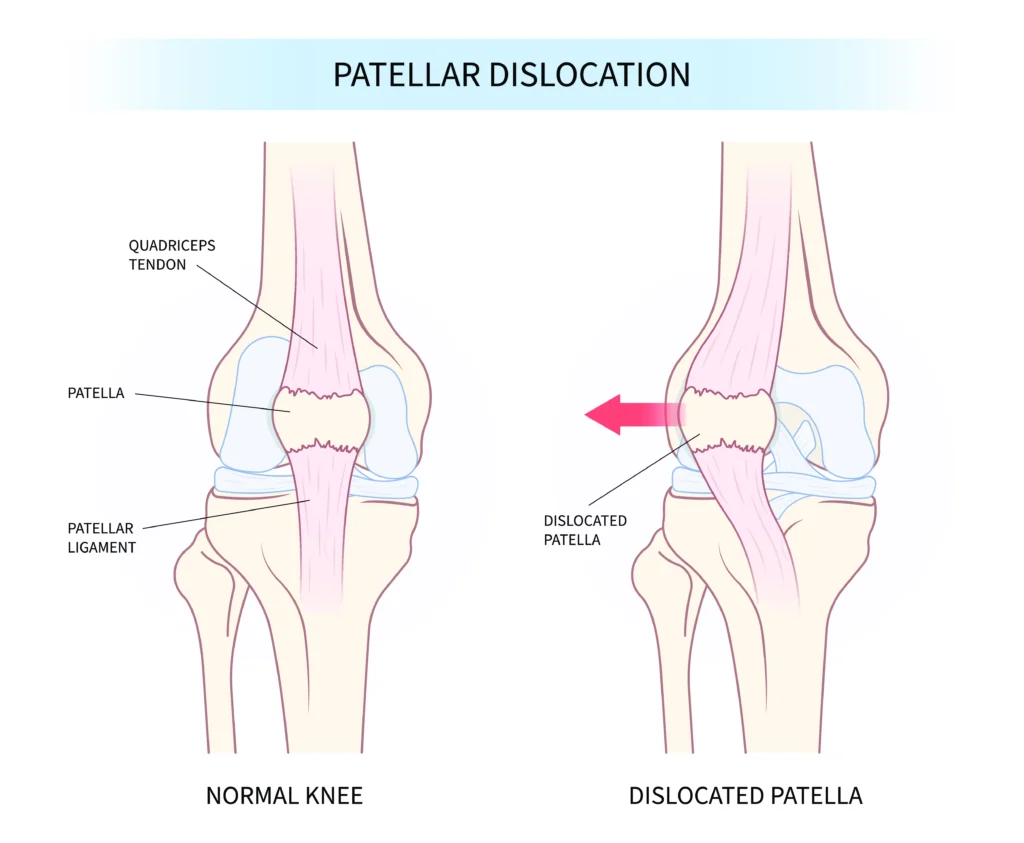
The patella, what most people call the kneecap, is a small, flat bone that sits at the front of your knee. It glides up and down in a groove called the trochlea, which runs along the end of the thigh bone (femur). This groove acts like a track, keeping the kneecap centered and stable as you bend and straighten your leg.
A patellar dislocation occurs when the kneecap slides completely out of this groove, most often to the outside of the knee. It’s different from a patellar subluxation, which is a partial slip where the kneecap doesn’t fully come out of position. Both can cause pain and instability, but a full dislocation tends to be more dramatic. In many cases, the kneecap pops back into place as the knee straightens. Other times, it may need to be gently guided back into position by a medical professional.
This injury is particularly common in teenagers and young adults, especially those who play sports. But it can happen to anyone, and certain structural features of the knee can make some people more vulnerable regardless of activity level.
What Causes a Dislocated Kneecap?
Patellar dislocations often result from a sudden twist of the knee, a direct blow to the kneecap, or landing awkwardly from a jump. Pivoting sports like soccer, basketball, and gymnastics tend to carry a higher risk. But trauma isn’t always the culprit. Some people are simply built with an anatomy that makes their kneecap less stable to begin with.
Several factors may increase the likelihood of experiencing a patellar dislocation:
- A shallow trochlear groove, which gives the kneecap less of a “channel” to sit in (known as trochlear dysplasia)
- Ligament laxity, or naturally loose ligaments throughout the body
- A kneecap that sits higher than normal, a condition called patella alta
- Muscle imbalances, particularly weakness in the hip and quadriceps muscles
- A prior history of dislocation. Once the kneecap dislocates, the supportive ligament on the inside of the knee (the medial patellofemoral ligament, or MPFL) may tear, which can increase the likelihood of future instability.
Signs and Symptoms to Watch For
Many patients describe a sudden pop or shift in the knee, followed by significant pain. The kneecap may look visibly out of position. Swelling often develops quickly, and many people find it difficult or impossible to walk right away.
Even after the kneecap returns to its normal position, symptoms often linger. You might experience a feeling that the knee is going to give way, tenderness along the inside of the kneecap, pain with bending or straightening the leg, or a sense of apprehension when moving the knee in certain directions. That lingering instability is worth paying attention to. It often signals that the MPFL may have been stretched or torn during the dislocation and may not be providing its usual level of support.
How Is a Patellar Dislocation Diagnosed?
When a patient comes in after a kneecap dislocation, your doctor may start by asking about how the injury happened and what symptoms they’ve been experiencing. From there, they will perform a thorough physical examination to assess swelling, range of motion, tenderness, and overall knee stability.
Imaging typically plays a role in the evaluation. X-rays help rule out bone fractures, since small pieces of bone or cartilage can sometimes break off during a dislocation. An MRI may also be ordered to evaluate the soft tissues, including the MPFL and the cartilage around the joint. This fuller picture helps with determining the extent of the injury and recommending the most appropriate treatment path for each patient.
Non-Surgical Treatment Options
For many patients, particularly those experiencing a first-time dislocation without major structural damage, non-surgical treatment is often where we begin. The goal is to allow the injured tissues to heal, manage pain and swelling, and rebuild the strength and stability the knee needs to function well.
If the kneecap hasn’t returned to its proper position on its own, the first step is to gently guide it back into the groove. Your doctor should manage this carefully and may use some form of pain relief to keep you comfortable during the process.
After that, treatment may include a combination of the following:
- A period of rest and reduced weight-bearing, sometimes with the help of crutches
- A brace or splint to stabilize the kneecap while early healing takes place
- Icing and anti-inflammatory medications to manage swelling and discomfort
- A structured physical therapy program to rebuild quadriceps and hip strength and improve kneecap tracking
Physical therapy tends to be a component of non-surgical recovery. A focused exercise program may help stabilize the kneecap and reduce the likelihood of a future dislocation. In some cases, PRP therapy may also be considered as a complementary option, particularly when there is associated soft tissue injury. While research in this area continues to evolve, PRP has shown potential in supporting the healing process for certain orthopedic conditions.
When Surgery May Be Necessary
Surgery isn’t always the answer after a patellar dislocation. Many patients do very well with non-surgical care. However, there are circumstances where a surgical approach may give the best chance at lasting stability.
I tend to discuss surgery more seriously when:
- The dislocation has happened more than once and instability keeps coming back
- Imaging reveals a confirmed MPFL tear that is unlikely to heal well on its own
- A bone or cartilage fragment needs to be addressed surgically
- The patient’s anatomy makes it unlikely that non-surgical treatment will provide durable stability
One of the more common surgical procedures for patellar instability is MPFL reconstruction. The MPFL is the primary soft tissue structure that prevents the kneecap from sliding outward. When it tears during a dislocation, it may not heal back to its original strength. Reconstructing it may help improve stability.
In some cases, a bony procedure may be considered as well. This often involves repositioning the tibial tubercle, the bony bump below the kneecap where the patellar tendon attaches, to improve alignment and reduce the forces pulling the kneecap out of its groove. For patients with significant trochlear dysplasia, additional procedures may also be worth discussing.
Every patient’s anatomy and injury history is different. I work to develop an individualized plan that reflects your specific goals and circumstances.
Can Future Dislocations Be Prevented?
Once you’ve had a patellar dislocation, the risk of having another one is real, especially if the MPFL was torn and hasn’t fully healed. That said, there are meaningful steps you can take to help protect your knee going forward.
Building strength in the muscles that support the knee is arguably the most important thing you can do. The quadriceps, particularly the VMO, which is the teardrop-shaped muscle on the inner side of the thigh, help guide the kneecap as the knee bends and straightens. Hip strength matters too. Weakness in the hips can cause the knee to cave inward, placing more lateral stress on the kneecap. Sticking with a targeted exercise program even after formal physical therapy ends may help protect your knee going forward.
Movement mechanics also play a role. Learning how to land from jumps, cut, and change direction in ways that reduce rotational stress on the knee can make a difference, especially for athletes. And if you’re noticing that your knee feels unstable or keeps threatening to give way, that’s a sign worth addressing sooner rather than later. Catching instability early often leads to better outcomes than waiting until another full dislocation occurs.
Summary
A patellar dislocation happens when the kneecap slips completely out of its normal groove on the front of the knee. It’s a relatively common injury, particularly among active teenagers and young adults, and it can stem from trauma, structural anatomy, or both. Most first-time dislocations may be managed without surgery through rest, bracing, and physical therapy. Recurrent dislocations or significant tissue damage may call for a surgical approach, such as MPFL reconstruction or a bony realignment procedure.
Recovery takes time, but with the right treatment plan and a commitment to rehabilitation, many patients return to the activities they care about. If you’ve recently experienced a patellar dislocation or are dealing with ongoing knee instability, I’d encourage you to reach out to my office so we can take a thorough look and talk through what makes sense for your situation.
Frequently Asked Questions
Can a dislocated kneecap heal on its own?
In some cases, the kneecap may slide back into its groove once the knee is extended, without any outside intervention. However, the underlying soft tissue damage, particularly to the MPFL, does not always heal fully on its own. Unaddressed instability can raise the likelihood of future dislocations and may contribute to longer-term joint damage over time.
How do I know if I need surgery after a patellar dislocation?
Surgery isn’t always necessary. For many patients with a first-time dislocation and no significant structural damage on imaging, non-surgical management may be appropriate. Surgical options tend to be discussed more seriously when dislocations are recurring, when the MPFL is confirmed torn and not healing well, when a bone or cartilage fragment needs to be addressed, or when anatomy is contributing to ongoing instability. A thorough in-person evaluation with an experienced knee specialist is the most reliable way to determine which path makes sense for your situation.
Is patellar dislocation common in teenagers?
Yes, patellar dislocation is frequently seen in adolescents and young adults, particularly those who are active in sports. Teenagers may face a somewhat higher risk due to factors like rapid growth phases, naturally loose ligaments, and the physical demands of athletic activity. That said, patellar dislocation can occur at any age.